READING EMILY DICKINSON:
Gothic, Haunting, Uncanny
  • Home
  • The Gothic
    • Introduction
    • The Gothic and its conventions
    • F339, “I like a look of Agony" and Maud: A Monodrama
    • F341, “Tis so appalling - it exhilarates” and The Wanderer
  • The Uncanny
    • Introduction
    • F360, "The Soul has Bandaged moments -"
    • F775, "Suspense – is Hostiler than Death –"
    • F440, “I Years had been from Home”
  • Trauma and Hauntology
    • Introduction
    • F 141, "She died at play - "
    • F 407 and F 344>
      • F 407, "One need not be a Chamber - to be Haunted - "
      • F 344, "'Twas just this time, last year, I died."
  • Bibliography

F360, "The Soul has Bandaged moments -"

Picture
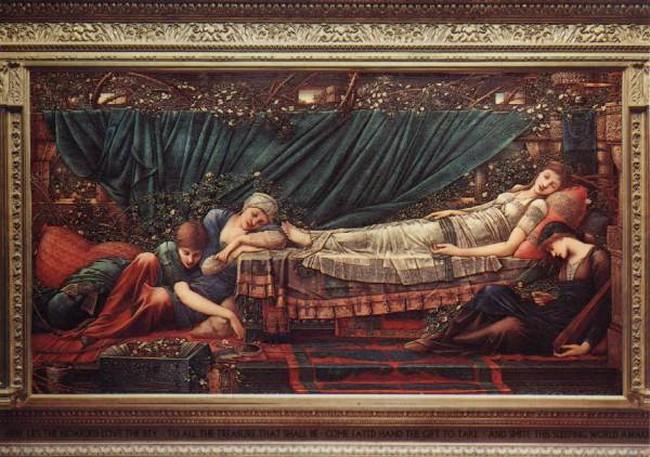
Edward Burne-Jones's "Rose Bower"

The Soul has Bandaged moments -
When too appalled to stir -
She feels some ghastly Fright come up
And stop to look at her -

Salute her, with long fingers -
Caress her freezing hair -
Sip, Goblin, from the very lips
The Lover - hovered - o'er -
Unworthy, that a thought so mean
Accost a Theme - so - fair -

The soul has moments of escape -
When bursting all the doors -
She dances like a Bomb, abroad,
And swings opon the Hours,

As do the Bee - delirious borne -
Long Dungeoned from his Rose -
Touch Liberty - then know no more -
But Noon, and Paradise

The Soul's retaken moments -
When, Felon led along,
With shackles on the plumed feet,
And staples, in the song,

The Horror welcomes her, again,
These, are not brayed of Tongue -


            Emily Dickinson’s poem F360, “The Soul has Bandaged moments –” reveals the uncanny nature of being “out of control.” In the poem, the Soul/soul fluctuates between times of uncontainable excitement and of a powerless state of paralysis. The speaker of F360 seems to be saying that this lack of moderation and self-control is inescapable. The first two stanzas explore the containment of the Soul. The word “Bandaged” is associated with wounds and, by extension, healing (F360 1). It refers to the binding of a wound; thus, the “Soul” is injured, which results in its being tied up (F360 1). In F360, “Bandaged” becomes synonymous with motionless because the “Bandaged moments” (F360 1) occur when the Soul is “too appalled to stir” (F360 2). The OED Online defines “appalled” as “[b]ereft of courage or self-possession at the sudden recognition of something dreadful” (“appalled, adj.”). Therefore, the Soul’s paralysis involves a loss of self, which the literary scholar Nicholas Royle includes in his definition of the uncanny: “The uncanny involves feelings of uncertainty, in particular regarding the reality of who one is and what is being experienced. Suddenly one’s sense of oneself (of one’s so-called ‘personality’ or ‘sexuality’, for example) seems strangely questionable” (Royle 1). The Soul is essentially frozen (“freezing” (F360 6)) in place, an image eerily reminiscent of death. Given the word “sudden,” which is in both the definition of “appalled” and Royle’s definition of “uncanny,” and the word “moments” (F360 1) in the poem, the Soul’s paralytic state is connected with time. The fact that “moments” (F360 1) is plural indicates, obviously, that the Soul becomes “appalled” more than once (F360 2), introducing the idea of repetition and, thus, cyclicality into the poem. This death-like state seems inextricably linked with temporality; it is simultaneously temporary and inescapable—an uncanny fact in and of itself.

            In the next lines, we learn that “some ghastly Fright” (F360 3) is the cause of these “Bandaged moments” (F360 1). The idea of “ghastly” relates to death as it is “[s]uggestive of the kind of horror evoked by the sight of death” (“ghastly/gastly, adj.”). However, the Soul—identified with the feminine “She”—does not see the “Fright” (F360 3): “She feels some ghastly Fright” (F360 3). Thus, this terrible and terrifying image, which causes her paralysis, is in fact a more tangible than visible entity, and the word “some” indicates that the entity is unidentified (F360 3). However, the “Fright” (F360 3) does see the Soul: It “stop[s] to look at her” (F360 4). The speaker leads us to believe the terrifying figure is behind the Soul because it can see her, but she cannot see it. This position allows the “ghastly Fright” to gaze at the Soul, which gives it a sort of power over the soul (F360 3). The relative position of the “ghastly Fright” also adds to the uncanny nature of this poem, evoking the eerie, uncomfortable “feel[ing]” that something or someone is standing behind you, out of sight (F360 3). It creates “a flickering sense (but not conviction)” of danger, the kind of threat posed by a lurking, potentially inhuman creature (Royle 1).

            In the second stanza, the “ghastly Fright” moves from merely gazing at the female Soul to touching her (F360 3): “Salute her, with long fingers/Caress her freezing hair” (F360 5-6). The creature greets the Soul in a very intimate manner, by stroking her motionless figure. As we saw earlier, the Soul is resting in a death-like state, which makes this a moment border on necrophilia. However, she does seem to have some awareness while in this state as “[s]he feels” the creature’s gaze on her and its physical touch (F360 3). The “Fright” (F360 3), which the speaker identifies in line seven as a “Goblin” (F360 7), “[s]ip[s]…from the very lips/The Lover – hovered – o’er – ” (F360 7-8). The “Lover” does not kiss the soul, but “hover[s]” over her frozen form (F360 8). This image is reminiscent of the fairy tale of Sleeping Beauty: The female trapped in a state between life and death, a liminal space, who must be kissed by the prince in order to awaken. However, this poem seems to be a perversion of this version of the tale because the “Lover” (F360 8) hesitates, then leaves her lips untouched, until the “Goblin” comes to do what the man will not (F360 7). However, the Soul remains unreleased from the “sleep”; neither the “Lover” (F360 8) nor the “Goblin” (F360 7) saves her. The literary scholar Molly Clark Hillard examines the appearance of this fairy tale in the nineteenth century, and she includes a review of the visual representations [one painting from this series is included above] of this liminal state: “A reviewer of Edward Burne-Jones’s last Briar Rose series contemplated the paintings with admiration and horror: ‘it is a sleep grown menacing as death…it is a presage and a prelude to the years to come, with their burdens of conscience, and their wages of winter and death’” (Hillard 5). The review could be applied to Dickinson’s poem as the quotation accurately portrays the Soul depicted in the first two stanzas of F360.

            The remaining lines of the second stanza are somewhat ambiguous: “Unworthy, that a thought so mean/Accost a Theme – so – fair –” (F360 9-10). It appears as though the speaker is calling the “Lover” (F360 8) “Unworthy” (F360 9) of the Soul, but “Unworthy” may also apply to the “Goblin” (F360 7) or even the Soul herself. Given the nature of the “ghastly Fright” (F360 3), or “Goblin” (F360 7), “Unworthy” (F360 9) most likely applies to this grotesque figure. Even the idea of this creature debases the “fair” Soul and her helpless state (F360 10). Incidentally, the OED Online lists “sexual intercourse” (“mean, n.1”) as an obsolete definition of the word “mean” (F360 9). This suggests a kind of rape scenario, a violation of the powerless female by the “Goblin” (F360 7). This inhuman creature violating not the physical body but the spiritual part of this female—the Soul—is disturbing to say the least. Dickinson’s reimagining of this fairy tale is uncanny because she creates “a peculiar commingling of the familiar and unfamiliar” (Royle 1), perverting the familiar story until it becomes unfamiliar.

            However, the poem reveals that “The soul has moments of escape” as well (F360 11). Dickinson’s use—or lack thereof—of capitalization here is interesting. When the soul is free, she does not capitalize the ‘S,’ but when the “Soul” is “Bandaged” she capitalizes the ‘S’ (F360 1). Perhaps, the soul is less proper when free, meaning both that she is less herself and acts less appropriately. Indeed, we see that, in her “moments of escape” (F360 11), “She dances like a Bomb, abroad” (F360 13). The soul becomes less inhibited in every sense of the word. She becomes explosive, “bursting all the doors” (F360 12). The soul destroys the barriers holding her in place; yet, this state—just like the uncanny, liminal one—is temporary as well. Her “swing[ing] opon the Hours” reminds us of that fact (F360 14). The amount of time the soul has to be free is finite. Therefore, she becomes explosive during it in order to take advantage of “the Hours” that she does have (F360 14). Dickinson compares the soul’s reaction to freedom to that of “the Bee” in a “delirious” state (F360 15). This delirium is yet another “disordered state…characterized by…maniacal excitement” (“delirium, n.”). The soul seems to oscillate between comatose and maniacal, never experiencing a state of moderation. The Soul and the soul represent two distinct conditions, almost two separate selves: “The uncanny has to do with a strangeness of framing and borders, an experience of liminality…It may thus be construed as a foreign body within oneself, even the experience of oneself as a foreign body” (Royle 2). The duality of the soul is uncanny. Her lack of a “normal,” moderate state is  “the very estrangement of inner silence and solitude” (Royle 2). There are two extreme facets of this single soul.

            The soul’s delirium occurs when she can “Touch Liberty” (F360 17). Here, freedom is represented as some tangible object that she may “[t]ouch” (F360 17), but it is also fleeting. She cannot hold onto “Liberty” (F360 17). This serves to reemphasize the temporary nature of her freedom: “Touch Liberty – then know no more –” (F360 17). Then, we see the return of the capital ‘S’ Soul, a prisoner once more: “When, Felon led along,/With shackles on the plumed feet” (F360 20-1). The idea of cyclicality is reintroduced here with the reappearance of the Soul and words such as “retaken” (F360 19) and “again” (F360 23), which denote repetition. The “shackles” provide a concrete image of imprisonment in order to reinforce the knowledge that the Soul cannot escape this state (F360 21). “The Horror” (F360 23), which presumably refers to the same “Goblin” (F360 7)/”ghastly Fright” (F360 3) from earlier, “welcomes her, again” (F360 23). This suggests that the Soul returns to her frozen state where she is “too appalled to stir” (F360 2). However, “These, are not brayed of Tongue” (F360 24), which means that the imprisonment of the Soul within her death-like state is not announced. The OED Online defines “bray” as “to utter a loud harsh cry; esp. of grief or pain” (“bray, v.1”). The paralysis strips the Soul of her ability to voice her grievances. Therefore, we are left with a female who can “feel” (F360 3) herself being violated by a “Horror” (F360 23), but she cannot stop it or even cry out against it. She completely loses control of herself, which creates a disturbing “crisis of the proper…(from the Latin proprius, ‘own’)” (Royle 1). The Soul experiences the same loss of self that she experiences in stanzas one and two, completing the cycle of “moments” (F 360 1) and leaving us with a strong sense of the uncanny.    

Powered by Create your own unique website with customizable templates.